Choosing office furniture requires a comprehensive consideration of multiple dimensions, including functional needs, usage scenarios, human health, and budget. Avoid focusing solely on appearance or price while neglecting core issues such as practicality and durability. Here are some specific selection guidelines:
Choosing office furniture requires a comprehensive consideration of multiple dimensions, including functional needs, usage scenarios, human health, and budget. Avoid focusing solely on appearance or price while neglecting core issues such as practicality and durability. Here are some specific selection guidelines:
I. Functional Adaptation: Meeting the core needs of office scenarios
The core value of office furniture is to "assist in efficient office work," so it's necessary to first clarify the usage scenarios and functional requirements:
1. Select functions based on spatial scene
- Open workstation area (for employees' daily work):
- Office desks: They need to meet the requirements of "computer operation + document storage". Prioritize models with drawers (for categorizing and storing stationery) and pre-drilled cable management holes on the desktop (to avoid messy wires). If team collaboration is frequent, consider modular combination desks (which can be spliced and expanded).
- Office chairs: The key is "support for prolonged sitting", which should include lumbar support and adjustable height/backrest angle (to suit different heights).
- Private office (for managers/focused work):
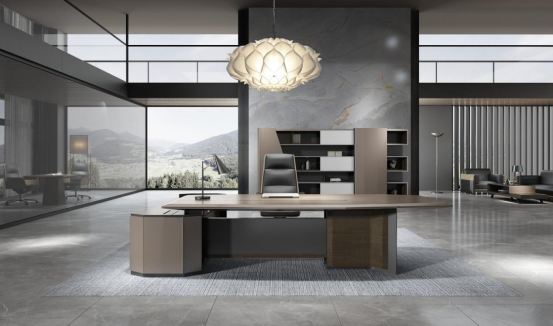
- Office desk: It needs to be able to accommodate both "office work and reception". Choose a style with a side cabinet (storage) and a desktop width of ≥1.6m (to place a computer, documents and tea set); it is recommended to choose wear-resistant and scratch-resistant solid wood veneer or rock slab (to enhance the texture).
- Reception area: Equipped with a simple sofa and coffee table. The sofa should be both comfortable and supportive (avoiding excessive softness that can cause fatigue from prolonged sitting).
- Conference table: Choose the size according to the number of people (choose a long table for less than 10 people, and an oval/round table for more than 10 people). The material should be wear-resistant (to avoid pen stains and water stains). You can choose one with a hidden cable box (for easy connection of projector and laptop).
- Conference chairs: lightweight and easy to move (with casters), with a moderate backrest height (to avoid obstructing the view of those behind).
- Storage area (document/equipment storage):
- Filing cabinets should be moisture-proof, have strong load-bearing capacity (the top layer should not deform when heavy objects are placed on it), and have a lockable design (to keep important documents confidential). If space is limited, floor-to-ceiling cabinets can be selected (to utilize vertical space).
- Tea cabinet: The countertop is waterproof (to avoid contact with water cups), and the interior is rationally divided (for storing coffee machines, tissues, etc.).
2. Special functional requirements
- Flexible office space: Choose height-adjustable desks (allowing for alternating standing and sitting to alleviate fatigue from prolonged sitting) and folding conference tables (quickly unfolded when temporarily expanding staff).
- Space saving: For small offices, prioritize "multifunctional furniture", such as folding tables (which can be folded up when not in use) and sofas with storage functions (file boxes can be placed underneath).
II. Ergonomics: Reduce fatigue from prolonged sitting and protect health
Office workers sit for more than 8 hours a day, and the ergonomic design of furniture directly affects their health. Pay close attention to the following:
1. Office chair: The core principle is "support".
- Lumbar support : It must have an adjustable lumbar support (to support the lumbar curve and prevent hunching). The lumbar support of inferior chairs is fixed (and cannot adapt to different body types).
- Chair back : The height should cover the shoulder blades (about 50-60cm), and the material should be breathable mesh fabric (to prevent sweating in summer) or high-density sponge (strong support).
- Adjustment functions : At least support "chair height adjustment" (feet flat on the ground, knees at 90°) and "chair back tilt angle adjustment" (can recline to about 120° during lunch break); if budget allows, models with adjustable armrests (armrest height is level with the table to avoid shoulders being unsupported) are available.
2. Desk: Height adapted to traffic flow
- The standard height is 75-78cm (suitable for most people when their elbows are naturally hanging down). If there are large differences in the height of team members, electric height-adjustable desks should be preferred (adjustable between 70-120cm, suitable for both standing and sitting).
- The desktop depth is ≥60cm (after placing a 15.6-inch computer and keyboard, there is still space to put documents, avoiding excessive forward arm extension).
3. Other details: Reduce physical strain
- Monitor stand: If your desk does not have a built-in riser, you can use an adjustable stand (to raise the screen to eye level and avoid looking down).
- Drawer design: The drawer is ≥15cm high (for easy storage of folders) and has internal dividers (for organizing small items such as scissors and USB drives to avoid wasting time searching for them).
III. Environmental Protection and Safety: Avoiding "Hidden Health Hazards"
The office environment is enclosed, and the environmental friendliness of the furniture directly affects indoor air quality, which requires close inspection.
1. Environmentally friendly materials (see "How to determine if materials are environmentally friendly" above)
- For engineered wood furniture: an ENF/E0 grade test report (formaldehyde emission ≤0.05mg/m³) is required, and the edges must be tightly sealed (without cracks or looseness).
- Fabric/leather furniture: Check for OEKO-TEX certification (formaldehyde-free, azo dye-free), and avoid furniture with pungent odors (be wary if there is still a sour smell/paint smell after ventilating for 1 week).
- Metal/Glass: The metal coating must be free of peeling (to prevent the release of heavy metals), and the edges of the glass must be rounded (to prevent impacts).
2. Security design (especially for multi-person office scenarios)
- Corner treatment: Right angles of desks and filing cabinets should be rounded (to avoid collisions and injuries), and furniture near children's play areas should be subject to even stricter requirements.
- Stability: Chairs and cabinets must be stable (swaying amplitude ≤1cm), and tall cabinets (≥1.8m) must be equipped with anti-tipping devices (fixed to the wall to prevent them from tipping over and injuring people).
IV. Durability: Reduces long-term usage costs
Office furniture is used frequently, and its durability directly affects the replacement cycle and cost; therefore, attention should be paid to materials and workmanship.
1. Material strength
- Board material: For office desks/cabinets, prioritize multi-layer solid wood boards (strong pressure resistance, not easy to deform) or high-density fiberboard (density ≥0.8g/cm³, better load-bearing capacity), and avoid low-density particleboard (easy to get damp and crack).
- Hardware: Hinges and drawer slides should be made of 304 stainless steel (rust-proof) or from well-known brands (such as Hettich and Blum). During testing, they should be able to be pulled smoothly without any jamming, and should not be loose when under load (e.g., the drawer can still be pushed and pulled smoothly even when it is full of documents).
- Fabric: Choose mesh fabric with an abrasion resistance index of ≥30,000 revolutions for office chairs (international standard; home-use grade is mostly 15,000 revolutions, office needs to be higher), or stain-resistant technical fabric (easy to wipe after coffee or ink spills).
2. Process Details
- Welding process: The weld points of metal frames (such as chair legs and table frames) must be flat and free of burrs (not scratchy to the touch), and there should be no missing welds (no abnormal noise when shaken).
- Painting process: The paint surface should be uniform (without bubbles or runs), and there should be no paint peeling when lightly scratched with a fingernail (to test abrasion resistance). Ask if it has undergone "yellowing resistance treatment" (to avoid discoloration after direct sunlight).
5. Space Fit: Avoid buying something too big that won't fit, or something too small that isn't enough.
1. Precise dimensional measurement
- Measure the office dimensions (length, width, and ceiling height) in advance and mark the locations of doors, windows, and sockets (to avoid furniture blocking switches/sockets).
- Reserve space for traffic flow: the passage between workstations is ≥80cm (for easy passage), and the distance between the desk and the wall is ≥50cm (for easy standing up and opening/closing cabinet doors).
2. Harmonious style
- Furniture style should match the overall office decoration:
- Modern minimalist style decoration: Choose furniture with straight lines and light colors (white/gray/natural wood color), and avoid complicated carvings.
- Industrial style decor: Furniture with metal frames and solid wood tabletops can be paired to highlight a rugged texture.
- Color control: No more than 3 colors of furniture in the same space (main color + secondary color + accent color) to avoid clutter (such as light gray tabletop + black chair frame + wood side cabinet).
VI. Cost and After-sales Service: Balancing cost-effectiveness and long-term guarantee
1. Budget allocation: Prioritize investment in frequently used furniture.
- High priority (8 hours of use per day): Office chair (20%-30% of budget, to avoid employees' back and neck problems due to cheap chairs), desk (25%-35%, durable materials are more cost-effective).
- Low priority (low-frequency use): tea cabinet, storage cabinet (choose a basic model with high cost performance).
2. After-sales guarantee
- Warranty period: Reputable brands offer a warranty of 5 years or more for hardware and 3 years or more for sheet metal/frame (avoiding short-term products with only 1 year of warranty).
- Installation service: Confirm whether on-site installation is included (especially for large furniture such as conference tables and tall cabinets, self-installation may easily lead to stability issues).
- Brand reputation: Prioritize brands with physical showrooms (to experience the quality firsthand) and check user reviews (focusing on whether the product deforms or peels after one year of use).
Summary: Selecting the core logic
- First, clarify the "spatial scenario + functional requirements" (e.g., open workstations should be flexible, while private offices should have a high-quality feel).
- Further verification of "ergonomics + environmental protection and safety" (health first, avoiding sacrificing comfort and environmental protection for low price);
- Finally, balance "durability + budget" (choose products with solid materials and good after-sales service to reduce long-term replacement costs).

